



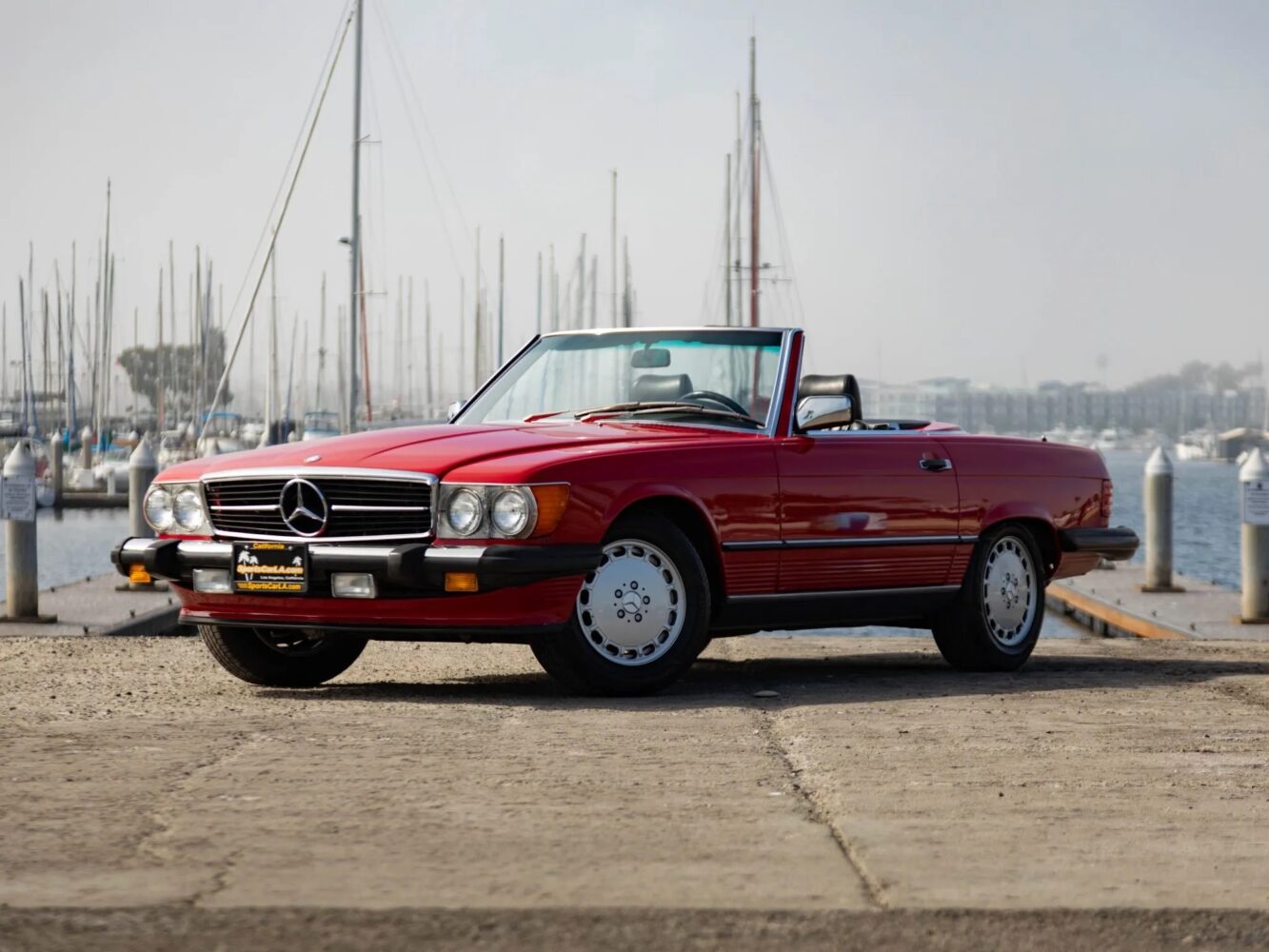
The Remarkable 18-Year Production Run
Few automobiles can claim the staying power of the Mercedes-Benz R107. Introduced in 1971 and remaining in production through 1989, the R107 enjoyed an impressive 18-year production run, making it one of the longest-lived passenger car platforms in Mercedes-Benz history.
What makes that accomplishment even more remarkable is the era in which it was built. During its production life, the automotive industry faced oil crises, changing emissions regulations, evolving safety standards, and rapidly advancing technology. While many manufacturers completely redesigned their vehicles every few years, Mercedes-Benz continued refining the R107 rather than replacing it.
The formula was simple: timeless styling, solid engineering, and a driving experience that remained relevant year after year. Mercedes-Benz steadily improved the platform with updated engines, safety enhancements, and comfort features, all while preserving the character that made the SL such an icon.
For many enthusiasts, the R107 represents a unique blend of old-world Mercedes craftsmanship and everyday usability. Whether equipped as a 450SL, 380SL, or the desirable 560SL, the R107 earned a reputation as a grand touring roadster capable of crossing decades without losing its appeal.
By the time production concluded in 1989, the R107 had become one of the most recognized Mercedes-Benz models ever built and remains one of the most approachable entry points into classic Mercedes ownership today.
R107 Production Timeline
| Year | Milestone |
|---|---|
| 1971 | R107 introduced as the 350SL |
| 1973 | 450SL introduced for the U.S. market |
| 1981 | 380SL replaces the 450SL in the United States |
| 1986 | 560SL becomes the flagship U.S.-market model |
| 1989 | Final year of R107 production |
| 1990 | R129 SL officially succeeds the R107 |
Engine Options Throughout Production
During its 18-year production run, the R107 was offered with a variety of inline-six and V8 engines depending on market and model designation. While European buyers had access to a wider range of engines, U.S.-market vehicles were primarily offered with V8 power.
| Model | Engine | Displacement |
|---|---|---|
| 280SL | Inline-6 | 2.8L |
| 300SL | Inline-6 | 3.0L |
| 350SL | V8 | 3.5L |
| 380SL | V8 | 3.8L |
| 420SL | V8 | 4.2L |
| 450SL | V8 | 4.5L |
| 500SL | V8 | 5.0L |
| 560SL | V8 | 5.6L |
U.S.-Market Models
| Model | Years |
|---|---|
| 450SL | 1973–1980 |
| 380SL | 1981–1985 |
| 560SL | 1986–1989 |
The 560SL represented the final evolution of the R107 for the North American market and remains one of the most sought-after variants today. Equipped with a 5.6-liter V8, upgraded brakes, and various refinements developed throughout nearly two decades of production, it served as the flagship U.S.-market R107 until production concluded in 1989.
Parts Availability
The R107 remains well-supported by Mercedes-Benz specialists and aftermarket suppliers, with many mechanical, cosmetic, and maintenance components still readily available. This strong parts network continues to make the R107 a practical and enjoyable classic to own.
Usable Collector Car
Unlike many collector vehicles that are reserved for occasional use, the Mercedes-Benz R107 was designed to be driven and enjoyed. Its combination of comfort, durability, and road manners allows many owners to regularly use their R107 for weekend drives, road trips, and enthusiast events. This balance of classic styling and real-world usability continues to make the R107 one of the most approachable collector cars on the market today.


